N5 トピック
L2: Here, There, and Everywhere
Point out and identify locations in the world
Here, There, and Everywhere
In this Topic, we're going to learn about another set of こそあど words.
While これ, それ, and あれ are used with objects, ここ, そこ, and あそこ are used with places. They roughly correspond to 'here', 'there', and 'over there'.
このトピックに出てくる文法
ここ
Here, This place
ここ is one of the forms of the これ family of words used to identify things close to the speaker. In this case it demonstrates a place. In the same way that これ represents 'this', ここ represents 'this place', or simply 'here'.
Fun Fact
The full family of words used for identification/demonstration in Japanese are referred to as こそあど言葉 (KO, SO, A, DO words). These include all of the different forms of これ, それ, あれ, and どれ.
Caution
ここ should not be confused with こっち, a similar word which is also sometimes translated as 'here'. こっち focuses more on the direction that one is/is going, while ここ focuses purely on 'this (stationary) place'.
そこ
There, That place
そこ is one of the forms of the それ family of words used to identify things close to the listener. In this case it demonstrates a place. Just like それ represents 'that', そこ represents 'that place', or simply 'there'.
In the same way that それ can be used to point back to something that was mentioned previously, そこ can be used to point back to a place that was mentioned previously.
Caution
そこ should not be confused with そっち, a similar word which is also sometimes translated as 'there'. そっち focuses more on the direction that one is/is going, while そこ focuses purely on 'that place'.
あそこ
Over there
Like ここ and そこ, あそこ is a word that is used to identify a place in Japanese. The place that あそこ will be used to identify is somewhere that is separated from both the speaker and the listener. This translates roughly to 'that place over there' in English. あそこ can be used to identify both physical locations, and emotional ones.
In the same way that あれ can be used to point back to something that was mentioned previously, あそこ can be used to point back to a place that was mentioned previously. However, unlike それ or そこ, あれ and あそこ will only be used this way when both the speaker and listener have intimate knowledge of the topic.
Caution
あそこ should not be confused with あっち, a similar word which is also sometimes translated as 'over there'. あっち focuses more on the direction that one is/is going, while あそこ focuses purely on 'that place'.
詳細
So, now that we understand the basic idea of こそあど words, let’s take a look at our Japanese deixis diagram (language spatial relationship diagram), and learn a bit more about how the Japanese language works as a whole.
Everything Everywhere All At Once
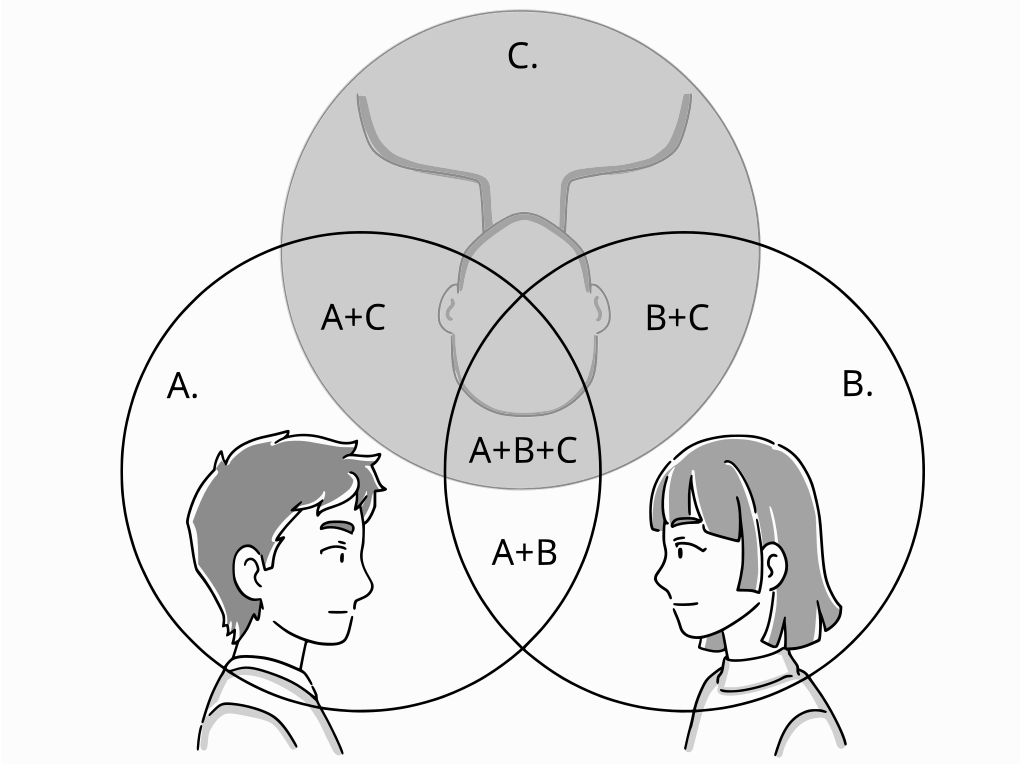
A - Knowledge that is intimate to こ.
B - Knowledge that is intimate to そ.
C - Knowledge that is intimate to あ.
A+B - Knowledge that is intimate to こ and そ.
A+C - Knowledge that is intimate to こ and あ.
A+B+C - Knowledge that is mutually intimate among all.
B+C - Knowledge that is intimate between そ and あ.
To not complicate things, let’s just focus on the fact that こ, そ, and あ represent any of the こそあど words in this diagram (regardless of whether it is a thing, a place, or a concept).
こ words will always refer to the speaker’s frame of reference, そ words will always refer to the listener’s frame of reference, and あ words can either refer to something that is shared knowledge, or distanced from both the speaker and listener.
Often in Japanese, subjects and pronouns etc. are left out, but one of the reasons for this is because the こそあど framework innately exists within any conversation. So, reference to any of these words will tell the listener straight away what kind of relationship the speaker has to it.
This is why it can sound like a speaker is trying to distance themselves from something (A+C) when they use あれ, when the ‘あれ’ in question is not shared knowledge (A+B+C). It’s like saying ‘Oh… That thing I know about but don’t want to think of as part of myself’. When both the speaker and the listener do know what it is about, though, it will come across as A+B+C. ‘We both know the thing… Don’t make me say it’.
We’ll learn about ど specifically a bit later. But in short, it is basically used for asking questions.
Tourist Troubles
--:--
サリー:「すみません。八百屋はここですか?」
ももこ:「ここは銀行です。八百屋はあそこです!」
サリー:「あそこ…。赤い建物ですか?」
ももこ:「あ、それは神社です!有名な日本の神社ですよ。八百屋はあそこの建物です!」
サリー:「見えます!ありがとうございます!」
ももこ:「いいえ。あ、そこも有名なレストランですよ!肉、魚も美味しい。パンもコーヒーも有名です。」
サリー:「ありがとうございます!晩ご飯は肉を食べます!」
ももこ:「行ってらっしゃい!」