N5 Topics
L2: I Won't Be Doing That! (Politely)
Make and use the polite and negative form of verbs
I Won't Be Doing That! (Politely)
In this Topic, we're going to learn how to take auxiliary verbs and attach them to regular verbs.
Auxiliary verbs are dependent words (words that cannot be used unless attached to something) that group with regular words to change their meaning or nuance. In this lesson, we will focus on ます and ない. ます allows us to convey verbs politely, while ない will allow us to say that something is ‘not’ happening.
We will also see the polite negative form (ません) and the semi-polite negative form (ないです).
Grammar in this Topic
ます
Polite Verb Endings
In traditional Japanese teaching, ます is introduced as something placed on the verbs to create the 'polite form'. While this is true, taking a bit of a closer look at what ます is by itself will help us understand the concept more clearly.
ます is an auxiliary verb, which means it is a word that connects to other words in order to change the meaning. For ます, this change occurs on verbs, and creates the polite form. To use ます, attach it to the conjunctive form of the verb.
Because most students see ます so early in their learning, the 'conjunctive form' is often simply called the 'ます form', or the 'ます stem' in many resources, as it may be easier to remember what to do with the verb that way.
Basically, ます is to verbs what です is to nouns and adjectives. They are both auxiliary verbs, and together they form the basis of polite language in Japanese.
Caution
In general, です and ます will only appear at the end of sentences. However, this is not a strict rule, as they are both occasionally used before conjunction particles such as が 'but' in very polite language.
Fun Fact
It is thought that ます originally came from 参らす 'to humbly do'. Over time it changed to まらす, then まっす, and then finally ます. 参る itself is a humble verb meaning 'to come' that is still used very frequently in modern Japanese.
Fun Fact
You will often hear the imperative form of ます, ませ in various set expressions. We will cover this in a set lesson on ませ!
る-Verb (Negative)
Will/Does/Do (not)
The negative form of る-Verbs are conjugated based on the same set of rules used for other forms of る-Verb conjugation (removal of る, followed by the addition of something else). In the case of negation, the additional component will be ない (casual), or ません (polite).
While the common translation of ない and ません is simply 'not', they actually have several possible nuances. These nuances are 'don't' (usually not), 'won't' (intentionally not), or 'can't' (unintentionally not).
Both ない and ません are auxiliary verbs (ません is a conjugation of ます), meaning that they have their own set of conjugation rules.
A semi-polite form may also be used. This is constructed by using ない, and then simply adding です. です is used to mark politeness here, and ないです sounds less formal and stiff than ません.
Caution
The ない attached to make the negative form of adjectives is a different word, and therefore follows different conjugation rules. When attached to adjectives ない itself is an い-Adjective, and not an auxiliary verb.
う-Verb (Negative)
Will/Does/Do (not)
The negative form of う-Verbs are conjugated based on the same set of rules used for other forms of う-Verb conjugation (changing the last kana, followed by the addition of something else). In the case of negation, the additional component will be ない (casual), or ません (polite).
As can be seen here, the kana change differs depending on whether ない or ません is being used. If ない will be used, the last kana will always change from the kana ending with a う sound, to the kana ending with an あ sound within the same row. If ません will be used, the change will be from the う sound kana to the い sound kana. The only exception to this rule are verbs that end in the kana う. Instead of changing to あ (the あ sound kana in the same row), う will become わ, when used with ない.
While the common translation of ない and ません is simply 'not', they actually have several possible nuances. These nuances are 'don't' (usually not), 'won't' (intentionally not), or 'can't' (unintentionally not).
Both ない and ません are auxiliary verbs (ません is a conjugation of ます), meaning that they have their own set of conjugation rules.
A semi-polite form may also be used. This is constructed by using ない, and then simply adding です. です is used to mark politeness here, and ないです sounds less formal and stiff than ません.
Caution
The ない attached to make the negative form of adjectives is a different word, and therefore follows different conjugation rules. The ない attached to adjectives is an い-Adjective itself, and not an auxiliary verb.
Details
Although we've just seen the conjugation rules for how to attach ます, ません and ない, let's take a closer look at the mechanics behind this. It is simpler than it seems!
One and Five Row Verbs
First, let's remind ourselves how verbs conjugate. In Japanese, る-Verbs are called 'one row (一段) verbs’ and う-Verbs are called 'five row (五段) verbs’. This is due to how their conjugations behave on a standard kana table.
る-Verbs are called 'one row' as their possible endings are locked into only one row. The stem of a る-Verb will always end in an い or え sound. る-Verbs that have a stem ending in an い sound are called 'upper one row' verbs (上一段), and る-Verbs that have a stem ending in an え sound are called 'lower one row' verbs (下一段). This is because they occupy one row of the kana table, one being upper and one lower. We can clearly see this on the chart below.
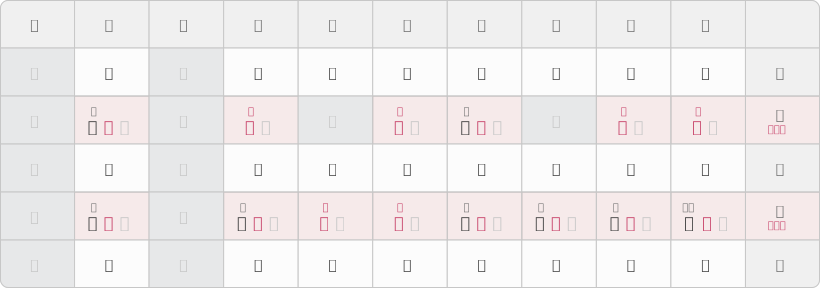
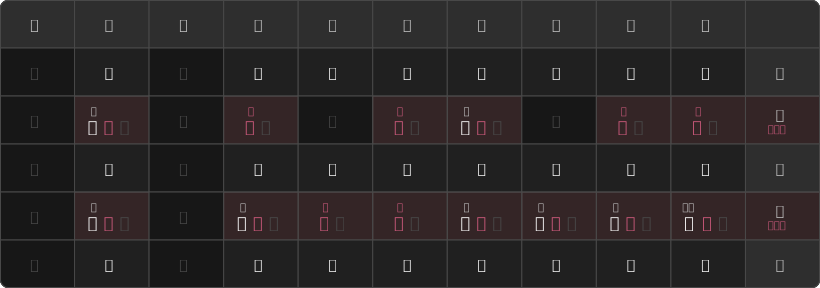
On the other hand, う-Verbs are called 'five row' verbs as their possible conjugations cover all five rows of the kana table, which we can see below.
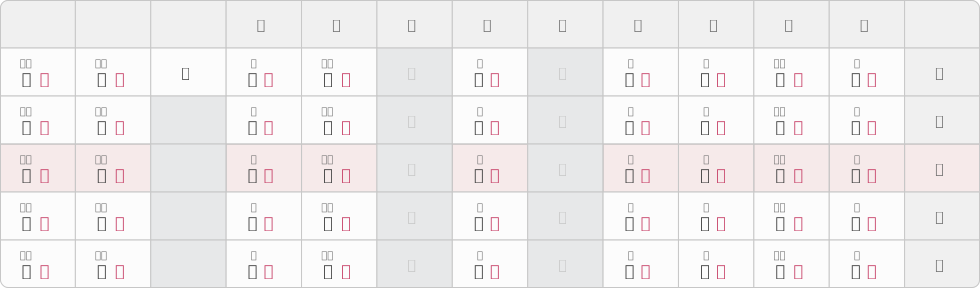
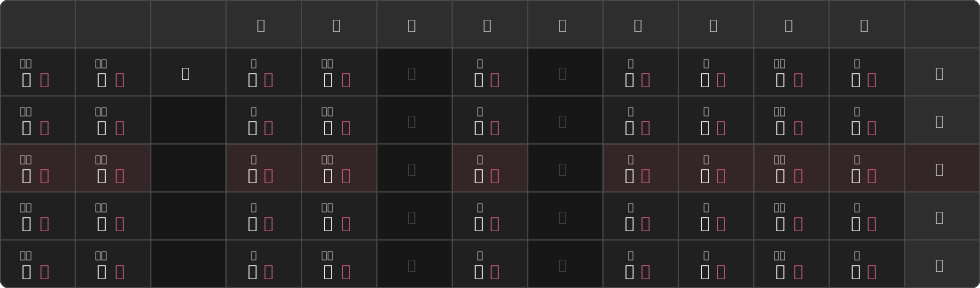
So, we end up with a series of possible forms to which auxiliary verbs can attach, the simple one for る-Verbs and the slightly more complicated one for う-Verbs.
For る-Verbs, we end up with a multi-purpose stem.
-
- + …
-
- + …
-
- + …
-
- + …
-
- + …
For う-Verbs, we end up with five possible conjugations, corresponding to the columns and rows on the kana table above. In this case, we have the possibilities for 話す 'to speak'.
-
さ
- + …
-
し
- + …
-
す
- + …
-
せ
- + …
-
そ
- + …
Add A Little Something...
Once we have the correct starting form, we simply glue whichever auxiliary verb we want to use onto the appropriate conjugation. For example, we now know ます and ない (and the negative form of ます, ません).
-
- +ない「+です」
-
- +ます
- +ませ+ん
-
- +る
-
- + …
-
- + …
-
さ
- +ない「+です」
-
し
- +ます
- +ませ+ん
-
す
- + …
-
せ
- + …
-
そ
- + …
Drill! Drill! DRILL!
Learning verb conjugation can feel a little tricky at first, but luckily, Japanese conjugation is overall very predictable. It can be picked up quickly with a little practice.
In Topics which cover conjugation rules there will be a link to our conjugation game, Kaijugation! Follow the link below to further practice the conjugation covered in this Topic.
In the Garden with Mom
--:--
娘:「これは木?」
母:「うん!桜の木ね。」
娘:「桜の木は大きいね!花が咲く?」
母:「そう!春、花が咲くよ!今日は咲かないよ。」
娘:「今日は花が見えない?」
母:「そうです。秋は花が見えません。春、花が開くよ。」
娘:「早くきれいな花が欲しいね〜!」